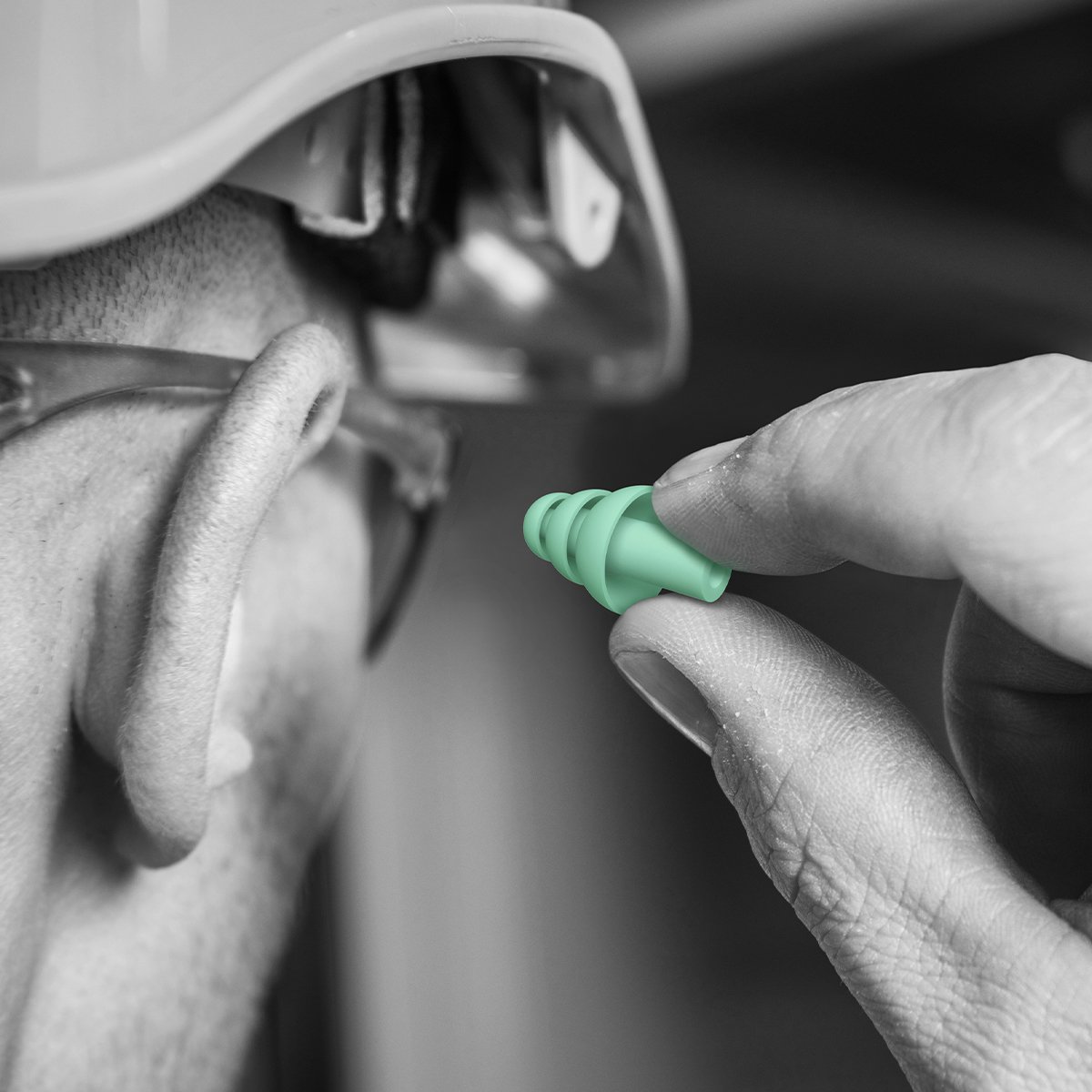
Yes, there are earplugs designed to fit both small and large ears. Most quality earplugs today come in multiple tip sizes or use materials flexible enough to adapt to different ear canal shapes and sizes. The fit depends less on the brand and more on the earplug type, material, and how the product is designed. Below, we cover everything you need to know to find a pair that actually works for your ears.
Why do so many earplugs feel like they don’t fit?
Most earplugs feel like they don’t fit because they were designed around an average ear canal size that simply doesn’t reflect the full range of human anatomy. Ear canals vary significantly in diameter, depth, and shape from person to person, and a one-size product rarely accounts for that range. When an earplug is too large, it creates pressure and discomfort. When it’s too small, it slips out and provides little to no protection.
Foam earplugs are a good example of this problem. They expand after being compressed and inserted, which works well for average-sized canals but can feel painful in smaller ears or fall out of larger ones. Hard silicone tips have a similar issue: they hold a fixed shape that either seals properly or doesn’t, with very little room for adjustment.
Beyond size, the shape of the earplug stem and tip matters too. Flanged earplugs with multiple ridges can catch on the outer ear canal in some people, while straight cylindrical plugs may not create a proper seal for ear canals that curve inward. Fit problems are common, but they are also solvable once you understand what’s causing them.
What earplug sizes and shapes are actually available?
Earplugs come in several distinct sizes and shapes, and the options have expanded considerably as hearing protection has moved beyond industrial use into everyday life. The most common formats include small, medium, and large tip sizes, often sold as interchangeable sets with a single earplug body. Beyond sizing, the main shape categories are cylindrical foam plugs, flanged silicone plugs, and molded or custom-fit plugs.
Flanged earplugs, sometimes called Christmas tree plugs, have two or three graduated ridges that help create a seal at different canal depths. These are popular for music and lifestyle use because they tend to sit more shallowly in the ear and feel less intrusive. Cylindrical foam plugs are the most widely available and the cheapest, but they offer the least flexibility for unusual ear shapes.
Custom-molded earplugs, made by an audiologist from an impression of your ear canal, offer the most precise fit but come at a significantly higher cost. For most people, a well-made universal earplug in the right tip size strikes the right balance between fit quality, comfort, and value.
How do you know which earplug size fits your ears?
The clearest sign that an earplug fits correctly is a noticeable reduction in ambient sound combined with no pain or pressure. A properly fitted earplug creates a seal without needing to be forced in. If you have to push hard to get it in, or if it keeps sliding out on its own, the size is wrong.
A practical way to test fit at home is to insert the earplug and then speak out loud or hum. Your voice should sound fuller and more resonant inside your head, sometimes described as the “occlusion effect.” If it sounds the same as without the plug, the seal is incomplete. If it causes discomfort or feels like it’s blocking your jaw movement, the earplug may be too large or inserted too deeply.
When trying a new earplug brand, start with the medium tip size if multiple options are included. Most adults with typical ear anatomy fit medium well. If you consistently experience discomfort or poor noise reduction, move to small or large accordingly. Children and adults with notably narrow canals almost always need small tips.
Do soft rubber earplugs fit better than silicone or foam?
Soft rubber earplugs generally fit a wider range of ear sizes better than standard silicone or foam alternatives. Synthetic rubber has a higher density than silicone, which means it conforms more precisely to the shape of the ear canal without relying on expansion or rigid structure to create a seal. This makes it more adaptable to both smaller and larger canals than foam, which expands uniformly regardless of the canal’s actual shape.
Foam earplugs work by expanding outward after compression, which creates pressure against the canal walls. This works reasonably well in average-sized ears but can be painful in narrow canals and unreliable in wider ones. Silicone flanged plugs hold a fixed shape, so if your canal doesn’t match the mold, the fit suffers.
Soft rubber sits between these two. It’s firm enough to hold its shape and create a reliable seal, but flexible enough to accommodate anatomical variation. It also tends to be more comfortable over long wear periods because it doesn’t exert the same outward pressure as expanding foam. For people who have struggled with fit using foam or silicone, soft rubber is often the material that finally works.
What’s the difference between universal fit and one-size-fits-all earplugs?
Universal fit earplugs are designed with adaptable geometry or multiple included tip sizes to accommodate a broad range of ear canal shapes and sizes. One-size-fits-all earplugs are designed around a single fixed size intended to work for most people. The terms are often used interchangeably in marketing, but they describe meaningfully different approaches to the fit problem.
True universal fit products typically include small, medium, and large tips so users can select the option that matches their anatomy. Some designs use a flexible stem or a graduated flange structure that adjusts passively to the canal shape during insertion. These products genuinely do fit a wider range of ears because the fit is tuned to the individual rather than averaged across a population.
One-size-fits-all products, by contrast, assume that a single shape will work for everyone. In practice, this works for people whose ear canals fall near the statistical average, but leaves people on either end of the size spectrum with a poor fit and reduced protection. When shopping for earplugs, look for products that explicitly offer tip size options or describe their design as adaptable rather than simply claiming universal fit.
Can earplugs still protect you if your ear canal is very small?
Yes, earplugs can still protect you effectively even with a very small ear canal, provided the earplug design accounts for shallow insertion depth. The key factor is where the protective filter or noise-blocking mechanism sits within the earplug. If protection depends on the plug being inserted deeply, a small canal will limit effectiveness. If the filter is positioned closer to the entrance of the canal, even partial insertion provides full protection.
This is one area where earplug design genuinely matters. Many standard earplugs require the tip to sit deep in the canal to block sound effectively. For people with small or narrow canals, this either isn’t physically possible or causes discomfort that makes consistent wear unlikely.
Our Shush Worker earplugs address this directly. The ceramic filter is positioned inside the earplug body rather than at the tip of the stem, which means protection is active even when the earplug only fits to the first layer of the canal. This internal filter placement makes a real difference for people with small ear canals who have previously found that earplugs either hurt or don’t seem to do much. Combined with soft synthetic rubber construction that adapts to the canal shape, Shush Worker earplugs deliver an SNR of 23 dB of reliable noise reduction without requiring a deep or forceful fit.
Frequently Asked Questions
How do I know if my earplugs are actually providing enough noise reduction for my situation?
The best indicator is whether you can still hear harmful or disruptive noise levels clearly while wearing them. Check the earplug's SNR (Single Number Rating) or NRR (Noise Reduction Rating) and compare it to the noise level you're trying to block — for example, a loud concert typically hits around 110 dB, so you'd want an earplug rated to bring that down to a safe or comfortable level. If sound still feels too loud or intrusive after a proper fit, you may need an earplug with a higher noise reduction rating or a better seal, not just a different size.
Is it possible to wear earplugs for 8+ hours without discomfort, even during work shifts?
Yes, but material and fit are the two factors that make or break long-wear comfort. Foam earplugs that expand against the canal walls tend to cause fatigue and soreness over extended periods because of the constant outward pressure they exert. Soft rubber or flexible flanged earplugs that conform passively to your canal shape are generally far more comfortable for all-day wear, especially when paired with the correct tip size.
What are the most common mistakes people make when inserting earplugs?
The most frequent mistake is not creating a proper seal — either by not inserting the earplug deeply enough or by skipping the step of pulling the outer ear back and upward to straighten the canal before insertion. For foam earplugs specifically, people often don't compress them small enough before inserting, which prevents them from seating correctly. Rushing the process or forcing an earplug that's the wrong size are also common errors that reduce both comfort and protection.
Can children use the same earplugs as adults, or do they need a completely different product?
Children almost always need small-sized tips or earplugs specifically designed for narrower, shallower ear canals, since adult-sized earplugs will typically be too large to fit properly and can cause discomfort or fall out. Some earplug brands offer dedicated children's versions, but many adult earplugs that include small tip sizes work well for older children. For young children or toddlers, earmuffs are often a safer and more practical alternative since fit and insertion depth are less of a concern.
Do earplugs affect sound quality differently depending on the type — for example, if I'm using them at a concert versus at work?
Yes, significantly. Standard foam and industrial earplugs block sound indiscriminately, which muffles and distorts music or speech rather than simply lowering the volume. High-fidelity or musician's earplugs use acoustic filters designed to reduce decibel levels more evenly across frequencies, preserving sound clarity — making them a much better choice for concerts, live events, or situations where you still need to hear voices or music clearly. For industrial or high-noise work environments where sound quality is less of a priority, standard noise-blocking earplugs with a higher NRR are typically the right tool.
What should I do if I've tried multiple earplugs and none of them seem to fit or stay in place?
If standard universal and foam options have consistently failed, the most effective next step is to try a different earplug material — particularly soft synthetic rubber — before assuming the problem is unsolvable. If you've already tried multiple materials and tip sizes without success, consulting an audiologist for a professional ear canal measurement or custom-molded earplugs is worth the investment, especially if hearing protection is important for your work or health. It's also worth checking whether earwax buildup is affecting the fit, as this is a common and easily overlooked factor.
How often should I replace my earplugs, and how do I know when they've stopped working effectively?
Disposable foam earplugs should ideally be replaced after each use, or at most after a few uses, since they collect earwax and lose their ability to compress and expand properly over time. Reusable silicone or rubber earplugs should be replaced when they show visible signs of wear — cracking, hardening, or deformation — or when you notice they no longer create a reliable seal even with the correct insertion technique. A good rule of thumb for reusable earplugs is to inspect them monthly and replace them every three to six months with regular use.