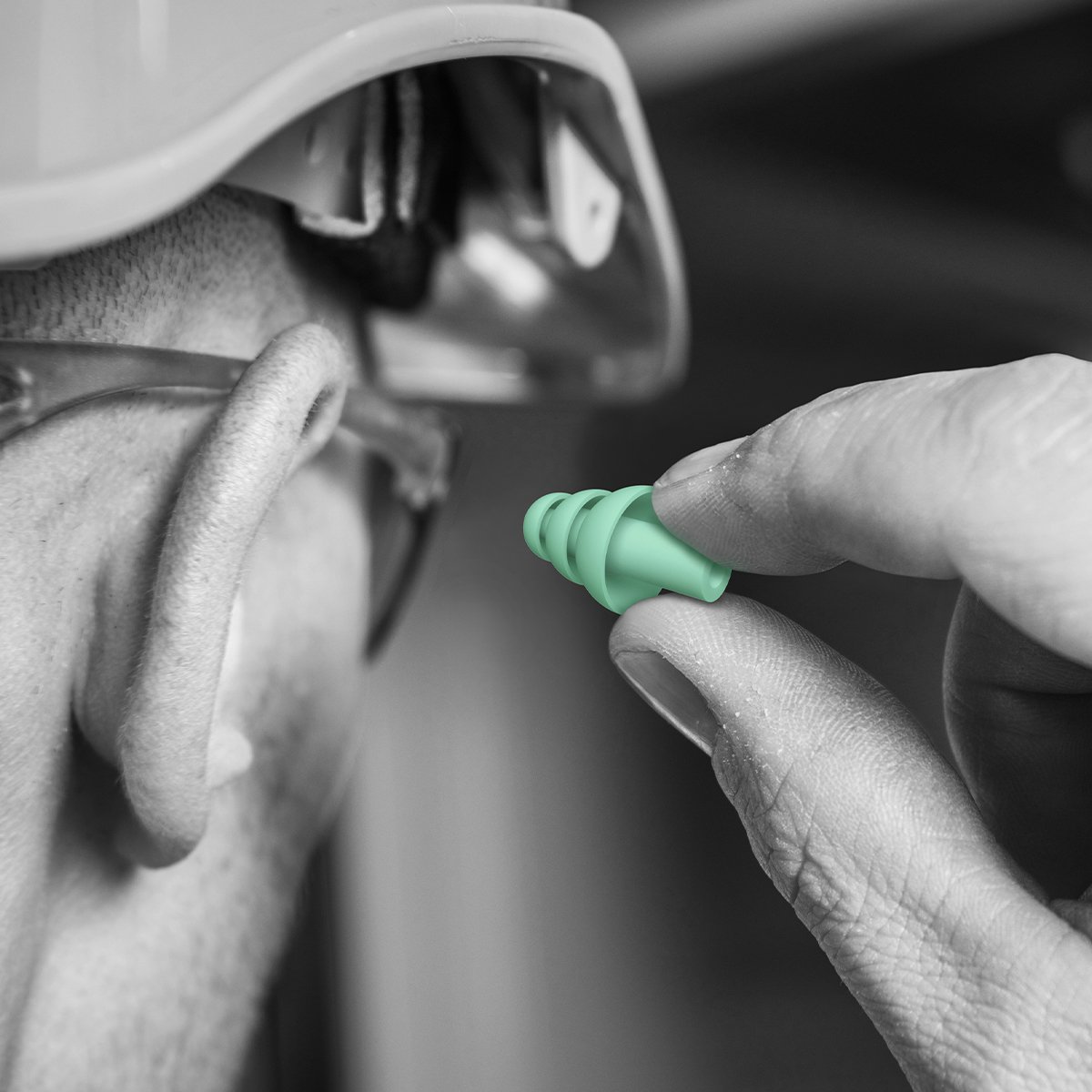
Hearing protection compliance means that a product has been tested and certified to meet established safety standards for noise reduction. Compliant earplugs carry an official rating that tells you exactly how much sound they block, giving you confidence that the protection is real and measurable. This applies to both professional hearing protection used on job sites and consumer earplugs sold for everyday use. Below, we break down the most common questions about what compliance means, how it works, and what to look for when you buy.
Why does hearing protection need to comply with standards?
Hearing protection needs to comply with standards because noise-induced hearing loss is permanent, and not all earplugs block sound equally. Without standardized testing, there would be no reliable way to know whether a pair of earplugs actually protects your hearing or just gives you a false sense of security. Compliance provides a verified, comparable measure of performance.
Noise-induced hearing loss builds up over time and often goes unnoticed until the damage is done. Regulatory bodies and occupational health organizations have established minimum performance thresholds to make sure that hearing protection products do what they claim. When a product meets those thresholds, it earns a certification that manufacturers are required to display on the packaging.
For workers in loud environments, compliance is often a legal requirement. Employers in manufacturing, construction, and similar industries must provide certified hearing protection to meet workplace health and safety regulations. For everyday consumers, compliance is a practical quality signal: it tells you the product has been independently verified rather than self-assessed by the brand.
What are the main hearing protection standards around the world?
The main hearing protection standards vary by region, but they all serve the same purpose: independently verifying that a product reduces noise to a safe level. The most widely recognized standards are EN 352-2:2020 in Europe, ANSI S3.19-1974 in the United States, CSA Z94.2-02 in Canada, and AS/NZS 1270:2002 in Australia and New Zealand.
Here is a quick overview of each:
- EN 352-2:2020 (Europe): The current European standard for earplugs, used in combination with EU PPE Regulation (EU) 2016/425. Products that meet this standard can carry the CE mark.
- ANSI S3.19-1974 (United States): The American National Standards Institute standard for measuring the noise reduction rating (NRR) of hearing protectors. The NRR figure on US packaging comes directly from this test method.
- CSA Z94.2-02 (Canada): The Canadian Standards Association standard, closely aligned with US and international methods for evaluating hearing protector performance.
- AS/NZS 1270:2002 (Australia and New Zealand): The joint Australian and New Zealand standard, which uses the SLC80 rating to express noise attenuation.
If a product is certified under multiple standards, it means it has been tested by an independent laboratory against each one separately. That kind of multi-region certification is a strong indicator of a product’s overall quality and reliability.
What does SNR mean on hearing protection packaging?
SNR stands for Single Number Rating, and it is the European measure of how much noise a hearing protector reduces on average. A higher SNR means more noise reduction. For example, an SNR of 23 dB means the product reduces incoming noise levels by approximately 23 decibels under test conditions.
The SNR is the European equivalent of the NRR (Noise Reduction Rating) used in the United States. Both figures come from laboratory tests, and both give you a single number that summarizes overall attenuation performance across multiple frequency bands.
It is worth knowing that real-world noise reduction is typically lower than the rated figure, because lab conditions are controlled and individual fit varies. That is why occupational safety guidelines often recommend applying a correction factor when calculating actual protection in the field. Still, the SNR gives you a useful benchmark for comparing products: a higher number means stronger protection, all else being equal.
How is hearing protection compliance tested and certified?
Hearing protection compliance is tested by an accredited, independent laboratory that measures how much sound is blocked across a range of frequencies. The lab recruits test subjects, fits them with the hearing protector according to the manufacturer’s instructions, and measures the difference in sound levels with and without the device. The results are then compared against the relevant standard’s requirements.
The testing process involves multiple participants and multiple fittings to account for natural variation in ear canal shape and size. The data is averaged to produce a single attenuation figure for each frequency band, which is then used to calculate the overall rating (SNR, NRR, or SLC80 depending on the standard).
Once the laboratory testing is complete, the manufacturer submits the results to the relevant certification body for review. If the product passes, it receives a certification mark, and the manufacturer is authorized to display the rating on the packaging. In Europe, this process also involves compliance with EU PPE Regulation (EU) 2016/425, which governs all personal protective equipment sold in the European market.
Certification is not a one-time event. If a manufacturer changes materials, filter design, or construction, the product typically needs to be retested to maintain its certification. This is why independent testing by a recognized third-party lab carries more weight than self-reported performance claims.
Does hearing protection compliance apply to everyday consumer earplugs?
Yes, hearing protection compliance applies to consumer earplugs as well as professional ones. Any earplug marketed for noise reduction, whether for concerts, travel, sleep, or workplace use, is subject to the same certification requirements as industrial hearing protection if it claims to reduce hazardous noise levels. The standards do not distinguish between professional and consumer use.
This matters because the consumer earplug market includes many products that look similar on the outside but perform very differently. Foam earplugs sold at a pharmacy and high-fidelity earplugs designed for musicians are both earplugs, but their attenuation levels, frequency response, and material quality can vary significantly. Certification tells you that a product’s claimed performance has actually been verified.
In the United States, there is no federal regulation requiring concert venues or clubs to limit sound levels, and many venues regularly exceed 110 dB, a level that can cause immediate hearing damage. For consumers attending live events or working in loud environments without employer-provided protection, choosing a certified earplug is the only way to know you are getting real, measurable noise reduction rather than a marketing claim.
What should you look for on a compliant earplug label?
On a compliant earplug label, you should look for a noise reduction rating (NRR in the US or SNR in Europe), the name of the standard the product was tested against, and the certification mark of the relevant body (such as the CE mark in Europe). These three elements together confirm that the product has been independently tested and meets a recognized performance threshold.
Here is a checklist of what to look for:
- NRR or SNR rating: A specific number expressed in decibels. If no number is listed, the product has not been rated.
- Standard reference: The name of the standard, such as EN 352-2:2020 or ANSI S3.19-1974, tells you which testing method was used.
- Certification mark: In Europe, look for the CE mark. In other regions, look for references to the relevant national or regional certification body.
- Testing laboratory: Some brands name the independent lab that performed the testing. This adds an extra layer of transparency.
- Material and fit information: While not a compliance requirement, details about the material (such as synthetic rubber vs. foam) and fit design give you useful context for comfort and long-term use.
If a label makes noise reduction claims without listing any of the above, treat that as a red flag. Genuine compliance is specific and verifiable, not vague.
Our Shush Worker earplugs are a good example of what full compliance looks like in practice. They carry an SNR of 23 dB and have been independently tested and certified by PZT GmbH against EN 352-2:2020 (Europe), ANSI S3.19-1974 (United States), CSA Z94.2-02 (Canada), and AS/NZS 1270:2002 (Australia and New Zealand). The ceramic filter design and durable synthetic rubber construction mean that the protection is consistent across wears, not just in a lab setting. If you are looking for a certified earplug that delivers clear, natural sound alongside verified noise reduction, that is exactly what we built them to do.
Frequently Asked Questions
How do I know if my workplace legally requires certified hearing protection?
In the United States, OSHA's Hearing Conservation Amendment (29 CFR 1910.95) requires employers to provide certified hearing protection to workers exposed to noise levels at or above 85 dB averaged over an 8-hour workday. If you work in manufacturing, construction, aviation, or any other loud industry, your employer is legally obligated to conduct noise monitoring and supply you with hearing protectors that carry a valid NRR rating. If you are unsure whether your workplace is covered, you can request a noise assessment from your employer or contact OSHA directly for guidance.
Does a higher NRR or SNR always mean better protection for my situation?
Not necessarily — the right rating depends on your specific noise environment, not just the highest number available. Over-protection can actually be a safety hazard in some settings, because it can prevent you from hearing important verbal warnings, alarms, or machinery sounds. The goal is to select a product whose rating brings your effective noise exposure down to a safe level, typically below 85 dB, rather than to simply maximize attenuation. A certified earplug with a moderate SNR or NRR that fits you well will outperform a high-rated earplug that fits poorly.
Can I use the NRR number on the package to calculate my actual noise exposure?
You can use the NRR as a starting point, but OSHA and the National Institute for Occupational Safety and Health (NIOSH) recommend applying a correction factor because real-world performance is typically lower than lab results. NIOSH recommends derating foam earplugs by 50% and other earplugs by 30% to better reflect actual field performance. For example, an earplug with an NRR of 23 dB would be estimated to provide roughly 11.5 dB of real-world protection under NIOSH's method. Always use these corrected figures when assessing whether a product provides sufficient protection for your noise environment.
What is the difference between certified earplugs and earplugs that just say 'noise reducing' on the packaging?
The difference is independent verification. A certified earplug has been tested by an accredited third-party laboratory against a recognized standard, and its noise reduction rating is a measured, documented figure. A product that only claims to be 'noise reducing' without listing an NRR, SNR, or standard reference has not been independently verified and may offer little to no measurable protection. In the US, the FTC requires that NRR claims be substantiated, but vague marketing language like 'noise reducing' or 'sound dampening' does not carry the same legal weight as a certified rating — so always look for the specific number and standard on the label.
How often should I replace certified earplugs to make sure they are still providing rated protection?
Replacement frequency depends on the earplug type and how often they are used. Disposable foam earplugs are designed for single use and should be discarded after each wearing, as they lose their shape and attenuation ability quickly. Reusable earplugs made from synthetic rubber or silicone can last much longer, but should be inspected regularly for cracks, hardening, or deformation, all of which reduce their protective performance. As a general rule, replace reusable earplugs at least every 6 to 12 months with regular use, or sooner if you notice any physical deterioration or a change in how they fit.
Are certified earplugs safe to use for sleeping or low-noise environments, or are they only for loud settings?
Certified earplugs are safe for use in any environment, including sleep, travel, or quiet settings where you simply want to reduce ambient noise. Certification confirms that the product meets safety and performance standards, but it does not restrict the contexts in which it can be used. That said, if you are using earplugs primarily for sleep or focus rather than hazardous noise exposure, comfort and fit become just as important as the attenuation rating. Choosing a certified earplug with a moderate SNR or NRR and a design suited for extended wear will give you both verified protection and all-day or all-night comfort.
What should I do if I find a product claiming certification but I cannot verify it independently?
If you cannot verify a product's certification claim, start by looking for the specific standard reference and testing laboratory name on the packaging or the brand's website — legitimate certifications will always name both. You can also search the certification body's public database; for example, CE-marked products in Europe must have a Declaration of Conformity that is available upon request from the manufacturer. If a brand is unable or unwilling to provide documentation of their third-party testing, that is a strong signal to look elsewhere. Transparency around certification details is a basic expectation of any reputable hearing protection manufacturer.